
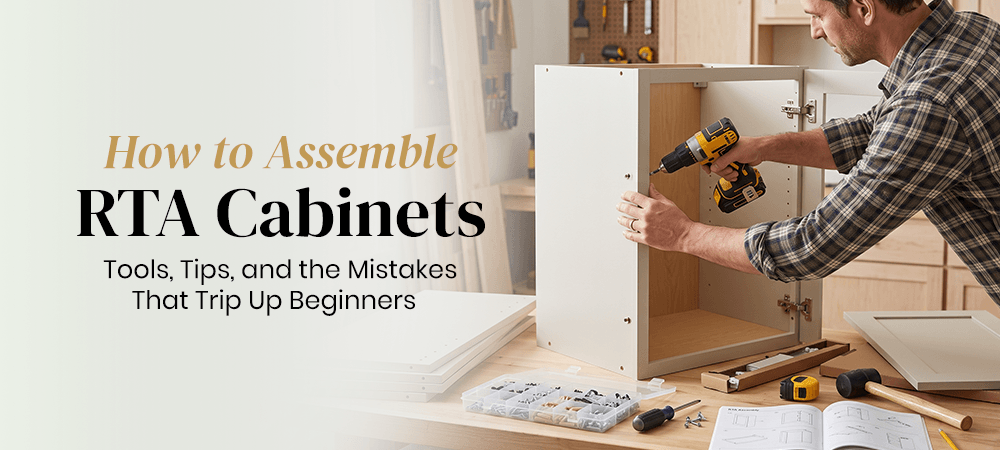
How to Assemble RTA Cabinets: Tools, Tips, and the Mistakes That Trip Up Beginners
The number one hesitation people have about ready-to-assemble cabinets is not price and not quality — it is the quiet worry that assembly will turn into a lost weekend of confusing parts and stripped screws. Let us put that fear to rest with real numbers: a typical RTA cabinet assembles in 15 to 30 minutes, a full kitchen is a comfortable weekend project for one or two people, and the skills required peak at "can use a screwdriver and follow a video." Here is the complete playbook, from the toolbox to the seven mistakes that cause virtually all RTA problems.
The Tools You Actually Need
No workshop required. Gather a #2 Phillips screwdriver (a drill with a clutch is faster — more on that below), a rubber mallet, a tape measure, a level, wood glue, and a flat, clean workspace such as a garage floor with a moving blanket or the empty kitchen itself. Optional but wonderful: a corner clamp to hold panels square, and knee pads, because you will spend some time at floor level.
Before You Open a Single Box
Resist the urge to start building immediately. First, check every box against your order and packing list, and inspect for freight damage — reputable sellers like RTA Cabinets Express want damage reported promptly, and it is far easier to resolve before assembly. Second, unpack one cabinet at a time; parts from two look-alike cabinets mixed together is a classic self-inflicted wound. Third, watch the assembly video for your cabinet type start to finish before touching a part. RTA Cabinets Express maintains a full assembly video library, and ten minutes of watching saves an hour of guessing.
How RTA Cabinets Go Together
Modern RTA cabinets use cam-lock fasteners — metal pins that seat into round cams which rotate a half-turn to pull panels tight — often combined with dowels, glue, and screws. The general sequence for a base cabinet: lay the side panels flat and insert dowels and cam pins; attach the back panel, which squares the whole box; add the bottom panel; lock all cams; glue where the manual says (and only where it says); attach the face frame if separate; install drawer glides and hinge plates while the box is still easy to maneuver; then doors, drawers, and shelves. Wall cabinets are the same dance with fewer parts.
Two rhythm tips from people who have built thousands: hand-tighten cams until the panel seats, then give the final quarter-turn only after checking the box is square; and install glides and hinges before the box gets heavy and awkward. Your first cabinet will take 45 minutes. Your fourth will take 15. It is genuinely satisfying.
The 7 Mistakes That Cause 90 Percent of Problems
- Overtightening cam locks. They pull panels snug; cranking past resistance strips the seat. Snug, square, quarter-turn, stop.
- Using a drill at full power. A drill is fine — with the clutch set low. Full-torque driving into engineered panels strips holes instantly.
- Skipping the square check. Measure diagonals corner to corner before final tightening; equal diagonals mean square. An out-of-square box telegraphs into crooked doors forever.
- Gluing the wrong joints. Glue is forever. Follow the manual: glue dowels and fixed panels, never anything the design intends to be adjustable or removable.
- Confusing similar panels. Left and right sides, tops and bottoms — check the pre-drilled hole patterns against the diagram before locking anything.
- Assembling on carpet or an uneven floor. Soft surfaces let boxes rack out of square as you work. Flat and hard, always.
- Rushing the first cabinet. Speed comes from repetition. Let cabinet one be your classroom.
Assembly vs. Installation: Know the Difference
Assembly is building the boxes; installation is fixing them to your walls level and plumb. Many homeowners happily do both, but a popular hybrid saves real money with professional results: assemble every cabinet yourself over a weekend, then hire a handyman or installer for a day to hang and level the runs. You capture the full RTA savings while the finished kitchen gets a pro's level lines. If you do install yourself, three rules carry most of the load: find and mark every stud; start from the highest point of the floor and level from there; and screw cabinets to studs through the sturdy hanging rail, never through thin back panels alone, connecting neighboring cabinets face-frame to face-frame with clamps before screwing.
How Long Will a Whole Kitchen Take?
Realistic budgeting for a typical 12-to-18-cabinet kitchen: one afternoon to receive, check, and stage boxes; one weekend day to assemble (two people make it social and faster); and one day to install, or a half-day for a hired pro. Compare that to the 8-to-16-week lead time of custom cabinetry, and the weekend starts to look like the bargain of the remodel.
When to Choose Pre-Assembled Instead
Honesty matters here: RTA is not for everyone, and that is fine. If you lack the time, the flat workspace, or simply the interest, RTA Cabinets Express sells every collection pre-assembled — same cabinets, built before shipping. Plenty of customers split the difference, ordering complex corner units and tall pantries assembled while building the straightforward boxes themselves. There is no wrong answer; there is only your weekend and your budget.
Your Support System
Nobody assembles alone. Between the step-by-step assembly video library, phone support at 866-595-4727 (Monday through Friday, 8 to 5, in English and Spanish), and email help, an answer is always minutes away. Stuck on a cam lock at 7 p.m. on a Saturday? The video has you. Missing a part? One call and replacement hardware ships out — it happens, and it is never a crisis.
The Bottom Line
RTA assembly is the most overestimated obstacle in home improvement: a mallet, a screwdriver, a video, and a free weekend stand between you and cabinet savings of 40 to 60 percent. Order your kitchen from RTA Cabinets Express — with 25 percent off via code KITCHEN25 — watch the videos, build the first box slowly, and enjoy the rare home project that is both easier than feared and more satisfying than expected.
Frequently Asked Questions
Can one person assemble RTA cabinets alone?
Yes — boxes are manageable solo, though a second pair of hands speeds up wall-cabinet hanging. Many customers assemble evenings after work, one or two cabinets at a time.
What if a part is missing or damaged?
Call or email with your order number and the part diagram reference; replacement hardware and panels ship promptly. Report freight damage as soon as boxes arrive for the smoothest resolution.
Do assembled RTA cabinets hold up as well as factory-assembled ones?
A properly assembled, glued, and squared RTA cabinet performs identically — the joinery is engineered for it. The KCMA certification testing our lines pass applies to the cabinet design and materials you are building.