
Plywood vs. Particleboard vs. MDF: Kitchen Cabinet Materials Explained
Two kitchens can look identical on installation day and age completely differently. Ten years in, one still closes softly and holds a full load of dishes; the other has sagging shelves, swollen sink bases, and hinges pulling out of crumbling holes. The difference was never visible in the showroom photo — it was in the materials. If you are comparing kitchen cabinets, this guide explains exactly what plywood, particleboard, MDF, and solid wood each do well, where each fails, and what a smart buyer should actually order in 2026.
The Four Materials in Every Cabinet Conversation
Solid wood
Real lumber — maple, birch, oak. This is what quality face frames, door frames, and dovetail drawer boxes are made of. It holds screws tenaciously, survives impacts, and can be sanded and refinished. Its one weakness: wide solid panels expand and contract with humidity, which is why even premium doors pair a solid wood frame with a plywood or MDF center panel — that is engineering, not cost-cutting.
Plywood
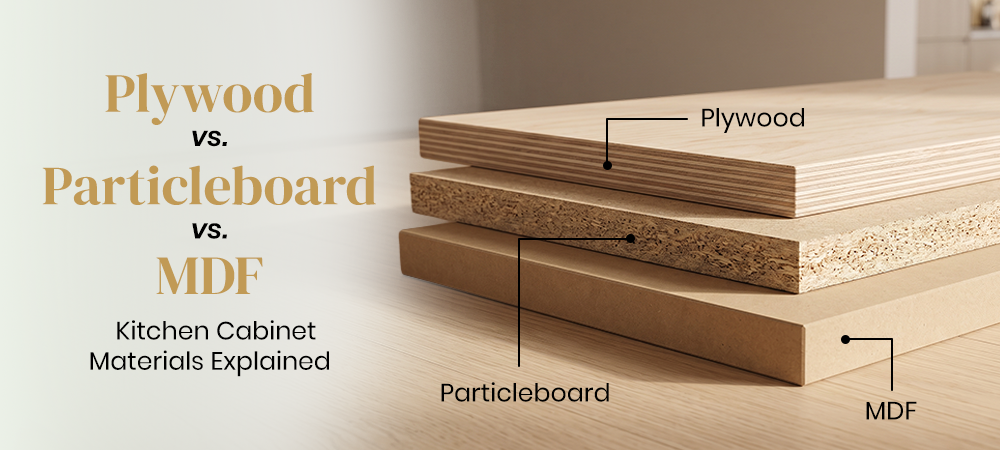
Thin layers of real wood veneer glued in alternating grain directions. The cross-grain structure makes it dimensionally stable, strong for its weight, highly screw-retentive, and far more moisture-tolerant than any particle-based board. Furniture-grade plywood is the gold standard for cabinet boxes — sides, backs, bottoms, and shelves.
Particleboard
Wood chips and sawdust pressed with resin. It is flat, cheap, and fine in dry, low-load applications, but it is the weakest of the four: it sags under sustained shelf loads, strips out screws under repeated force, and — critically — swells irreversibly when water reaches an unsealed edge. Under a kitchen sink, that is a matter of when, not if.
MDF (medium-density fiberboard)
Fine wood fibers pressed into a dense, perfectly smooth board. MDF is heavier and much denser than particleboard, and its glass-smooth, grain-free surface makes it the best painting substrate in the industry — which is why many painted door center panels and some premium painted doors use it deliberately. Like particleboard, it dislikes standing water, so quality sealing and finishing matter.
Where Each Material Belongs
A well-engineered cabinet is not one material — it is the right material in each position. The configuration to look for: solid hardwood face frame and door frame; plywood box, shelves, and drawer bottoms; dovetailed solid wood drawer boxes; and a center door panel of plywood or MDF depending on whether the finish is stain or paint. This is precisely how the collections at RTA Cabinets Express — Heritage White Shaker, Saddlewood, Onyx Shaker, and the rest — are built, with all-plywood construction available where it counts most.
Plywood vs. Particleboard: The Head-to-Head That Decides Your Box
- Screw holding: plywood grips threads through alternating wood layers; particleboard strips under repeated stress. Hinges and drawer glides live and die on this property.
- Moisture: a plumbing drip that a plywood sink base shrugs off will permanently swell and crumble particleboard. Kitchens are wet rooms; plan accordingly.
- Shelf sag: loaded with dinnerware, three-quarter-inch plywood shelves stay flat for decades; particleboard shelves of the same thickness measurably bow within a few years.
- Weight: plywood is lighter per unit of strength — relevant when wall cabinets hang from four screws.
- Cost: particleboard is cheaper to make. The finished-cabinet price difference, however, is modest — especially in the RTA model, where logistics savings absorb the upgrade.
The verdict is not subtle: for kitchen boxes, plywood is worth it, and the upgrade costs least when buying RTA.
The MDF Nuance Most Buyers Miss
MDF has an unfair reputation because bargain furniture abused it. In cabinetry, MDF in a painted center door panel is often the correct engineering choice: it is dead flat, never telegraphs wood grain through paint, and does not crack paint at frame joints the way seasonal wood movement can. Judge MDF by its position — center panel of a painted door, yes; structural box of a budget cabinet, no.
Reading a Spec Sheet Like a Pro
When you shop online, the product page tells you everything if you know the vocabulary. Look for phrases like "all-plywood construction," "solid wood face frame," "dovetail drawer box," and "three-quarter-inch adjustable shelves." Be wary of vague terms like "engineered wood" (usually particleboard), "wood veneer exterior" (veneer over particleboard), or "composite construction." If the spec sheet does not say plywood, it usually is not. And check for certifications: KCMA testing subjects real cabinets to loaded-shelf, slam, and moisture trials, while CARB-2 compliance caps formaldehyde emissions from composite boards — meaningful for the air your family breathes. RTA Cabinets Express carries both, on every line.
What About Thermofoil and Melamine?
Thermofoil (vinyl heat-wrapped over MDF) delivers a low-cost seamless look but is vulnerable to heat — peeling near ovens and self-cleaning cycles is its signature failure. Melamine (resin-infused paper over particleboard) is durable and cleanable, popular in garage and closet systems, but edges chip and the substrate remains particleboard. For a primary kitchen you plan to keep, painted or stained wood doors over plywood boxes remain the durability-per-dollar champion.
Material Questions to Ask Before Any Cabinet Purchase
What is the box made of, and is all-plywood standard or an upgrade? What is the door frame and center panel? Are drawers dovetailed solid wood, and what are the glides rated for? How are shelf edges sealed? Is the line KCMA certified and CARB-2 compliant? Any seller worth your money answers instantly. When we get these questions at 866-595-4727, we consider it a good sign about the caller — materials-literate customers become our happiest ones, because our spec sheets hold up under interrogation.
The Bottom Line
Cabinets fail from the inside out: the wrong board under a sink, the wrong shelf under the dishes, the wrong substrate under a hinge. Pay for plywood where water and weight live, accept MDF where paint needs perfection, insist on solid wood where screws bite and hands touch — and verify it all with certifications and a sample door. That is exactly the construction philosophy behind every collection at RTA Cabinets Express. Order a sample, request your free 3D kitchen design, and buy your next kitchen on specs, not vibes.
Frequently Asked Questions
Is all-plywood construction worth the extra cost?
For base cabinets and anything near water, emphatically yes — moisture resistance and screw retention are where plywood repays you. In the RTA model the upgrade is modest, often a few hundred dollars across a whole kitchen.
Are MDF cabinet doors bad?
No — painted shaker doors with MDF center panels are an industry-standard engineering choice that prevents paint cracking at joints. MDF as a structural box material in bargain cabinets is the version to avoid.
What material lasts longest for kitchen cabinets?
Solid hardwood frames and doors over all-plywood boxes, protected by a factory catalyzed finish — a combination that routinely serves 20 to 30 years. It is the standard build across RTA Cabinets Express collections.